ADHD
Breaking the Cycle of Avoidance: A Journey Towards Educational Re-engagement
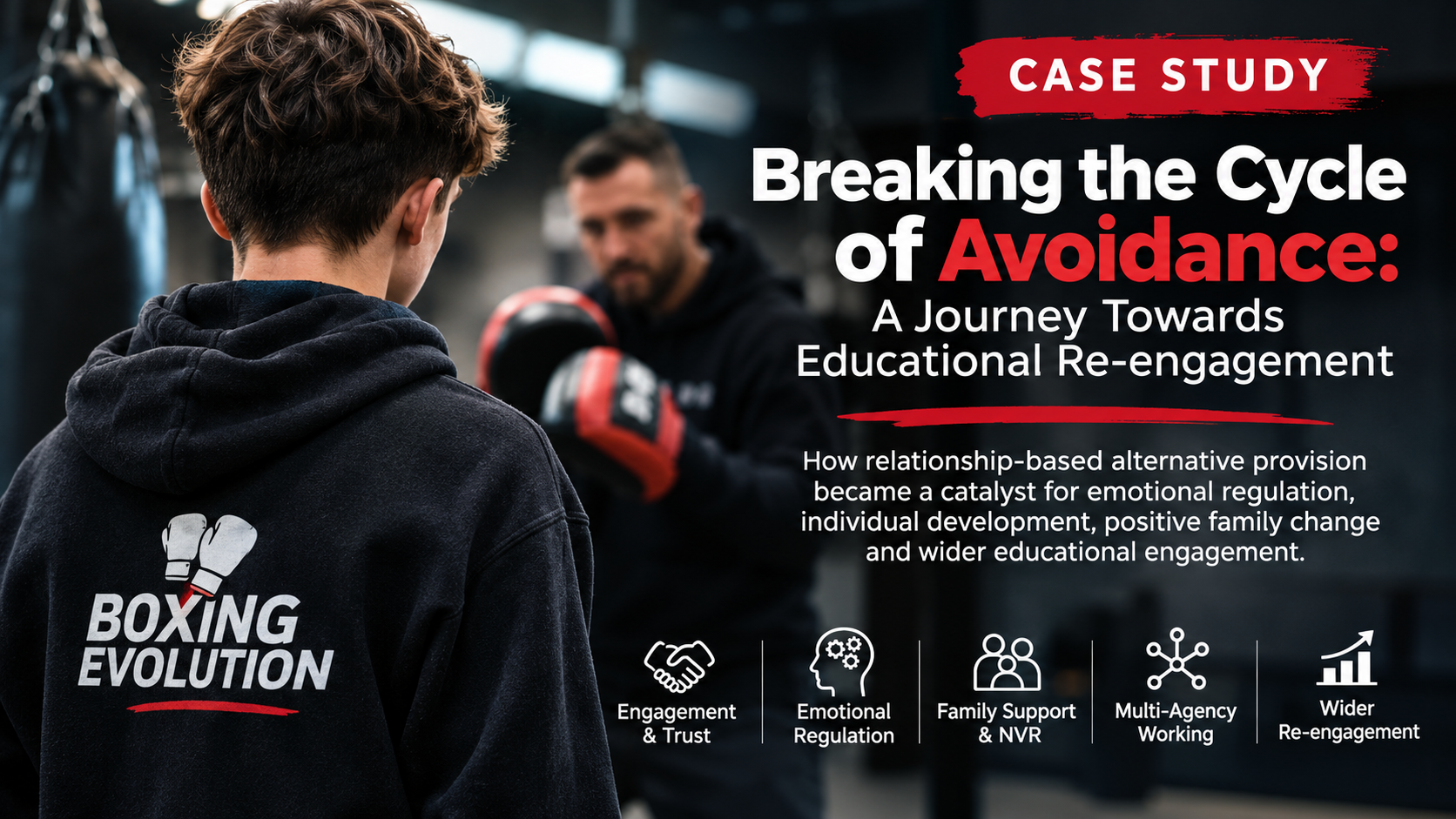
How relationship-based, activity-led alternative provision helped a young person overcome barriers to engagement, develop emotional regulation and self-belief, and progress towards a wider network of educational and specialist support.
“This is the first alternative support that Jay [name changed for privacy] engaged with and was the catalyst to other areas for improvement. It has been an incredibly positive experience.”
— Parent feedback, final placement review
This case study has been anonymised to protect the identity of the young person and family. Outcomes are based on practitioner observations, placement reviews and parental feedback. They reflect the young person’s individual experience within a wider network of professional support.

First allow me to introduce myself. I’m Matt Flavell, the founder of Boxing Evolution Ltd, where for over 15 years, I’ve dedicated myself to reshaping 1000’s of people’s lives helping them reach their full potential, through the power of boxing, underpinned by teaching the psychology of success and mentorship.
Background and Presenting Difficulties
J was referred to Boxing Evolution following a prolonged period of significant disengagement from education. At the point of involvement, he had been largely out of formal education for approximately a year and had experienced considerable difficulty engaging consistently with education and other professionals.
J had a diagnosis of ADHD alongside a Pathological Demand Avoidance (PDA) profile. Demand avoidance can co-occur with ADHD and other neurodevelopmental differences, presenting additional challenges around anxiety, perceived demands, emotional regulation and the need for autonomy.
Presenting concerns included:
Poor educational engagement.
Anxiety around leaving the home and participating in provision.
Difficulties with emotional regulation.
Impulsive decision-making.
Peer-related concerns.
Difficulties accepting boundaries and adult guidance.
Disrupted routines and sleep patterns.
Increasing behavioural challenges within the family home.
Mum and Dad were actively attempting to support J but were experiencing increasing difficulties managing behaviour, maintaining consistent boundaries and encouraging engagement with education and other interventions.
The initial priority for Boxing Evolution was therefore not academic attainment. It was to establish a meaningful relationship with J, increase engagement and create a foundation from which wider educational and developmental progress could become possible.
Establishing Engagement Through Trust
At the beginning of the intervention, J was refusing to engage with other professionals, making the establishment of a meaningful and trusting relationship a particularly important first step towards wider re-engagement.
Engagement initially required considerable flexibility.
J could be reluctant to leave the home and experienced anxiety around attending activities. Rather than attempting to force immediate compliance, the early intervention focused on establishing trust and giving J an appropriate degree of control. During the early stages, this meant that initial sessions were conducted at the home. Further down the line, J was reassured that if he attended a session and subsequently wanted to return home, this would be respected.
This reduced the perceived pressure associated with leaving the home, allowing J to engage without feeling that he was committing himself to a situation from which he could not withdraw. This also involved discussions with J around the concept of comfort zones, distinguishing between rational and irrational fears, and understanding how avoidance can reinforce anxiety and limit personal development.
J was encouraged to recognise the importance of gradually taking manageable steps outside his comfort zone, learning to tolerate the discomfort associated with unfamiliar or challenging situations and, in doing so, progressively expanding his horizons.
The objective was not simply to accommodate J’s existing anxieties, but to help him develop the confidence and coping mechanisms required to manage them more effectively, reducing the extent to which anxiety dictated his decisions and limited his opportunities.
Over time, this changed significantly. As trust developed, J became increasingly willing to leave the house and attend sessions without the level of negotiation or reassurance initially required.
Boxing proved particularly effective as an engagement vehicle. The coach–boxer relationship created clear roles, expectations and boundaries while simultaneously allowing rapport to develop through shared activity rather than relying solely upon conventional talking-based intervention.
The significance of the relationship established through boxing became particularly apparent during a multi-agency professional meeting, when Mum commented:
“Matt can just be direct with J and he listens. I don’t know how he does it.”
Boxing Evolution explained that an important factor in this was the coach–boxer dynamic established through training, through which J accepted Matts leadership.
Within boxing, receiving instruction, accepting correction, responding to feedback and being challenged are natural and expected components of the activity. This creates an environment in which direct communication and constructive challenge can become associated with personal development rather than criticism or confrontation.
As the mentoring relationship developed over time, this dynamic increasingly extended beyond the gym, enabling Boxing Evolution to have direct conversations with J about his behaviour, decision-making and situations occurring within his everyday life.
This was particularly significant given that, at the beginning of the intervention, J had been refusing to engage with other professionals.
Boxing was not simply the activity being delivered. It was the mechanism through which the mentorship relationship could be established.
#Key take away: Effective alternative provision is about more than engaging a young person in an activity. It is about using that engagement to build trust, develop transferable skills, identify underlying barriers to progress and facilitate access to appropriate wider support.
The principles underpinning the Boxing Evolution intervention are consistent with wider research into anxiety-based avoidance, targeted youth mentoring, behavioural development and family-based interventions. Read the full study here.
Using Boxing as a Vehicle for Development and Functional Assessment
Boxing Evolution combined boxing and physical training with mentoring and principles drawn from performance psychology.
Sessions were used not simply as opportunities for physical activity but as environments in which behaviours relevant to J’s functioning outside the gym could be observed, explored and developed.
These included:
Emotional regulation and frustration tolerance.
Accepting instruction, correction and adult guidance.
Perseverance when tasks became difficult.
Slowing down decision-making.
Managing impulsive reactions.
Tolerating discomfort and uncertainty.
Developing confidence and self-belief.
Communication and accountability.
Personal responsibility.
Physical training provided opportunities to observe behaviours that may not have been as apparent within conventional professional meetings.
How J responded to frustration, correction, challenge, fatigue, success and failure provided useful functional information that could subsequently be explored through mentoring.
The relationship developed through training also enabled conversations about situations occurring outside sessions without these becoming overly formal or confrontational.
This represents an important additional function of activity-led alternative provision: the ability to observe how a young person responds to real-time demands and challenges, rather than relying exclusively on self-reporting or retrospective accounts of behaviour.
Emotional Regulation and Decision-Making
Emotional regulation became an increasingly important focus of the intervention.
J could respond rapidly when emotionally activated and sometimes felt a strong need to resolve situations immediately. This was particularly evident in relation to peer difficulties, perceived unfairness and uncertainty.
Through working with Boxing Evolution, Jay developed skills around, recognising emotional activation, creating a pause between emotion and action, tolerating uncertainty and making more considered decisions.
This approach allowed real-life incidents to become learning opportunities, helping J develop skills that could be applied beyond the training environment.
Identifying Wider Barriers to Progress
As the intervention developed, Boxing Evolution identified that further progress with J could not necessarily be achieved solely through increasing the amount of direct one-to-one work with him.
Although J had developed a positive relationship with the intervention and was demonstrating improvements in several areas, some of the remaining barriers appeared to be associated with the wider home environment.
In particular, concerns emerged around:
Inconsistent approaches between Mum and Dad.
Weakened household and personal boundaries.
Differences in how challenging behaviour was addressed.
Difficulties maintaining routines and expectations.
Ongoing child-to-parent abuse and controlling behaviours.
Difficulties within the parental relationship affecting consistency.
Rather than interpreting continuing difficulties as evidence that J simply required more mentoring, Boxing Evolution considered what factors outside the sessions were preventing the skills being developed through the intervention from becoming embedded consistently in everyday life.
This became an important turning point in the placement.
Recognising Child-to-Parent Abuse and Controlling Behaviours
During the intervention, several incidents were observed or reported that raised concerns regarding emerging child-to-parent abuse and controlling dynamics within the family home.
These included:
J locking Mum out of the family home while the Boxing Evolution practitioner was present.
Demanding to know who Mum was speaking to during telephone conversations.
Sending highly verbally abusive voice messages to Dad.
Demonstrating limited regard for household boundaries.
Inviting individuals into the family home at inappropriate times without sufficient consideration of parental expectations or safety.
On one occasion, while Mum was speaking with Boxing Evolution by telephone, J could be heard demanding to know who she was speaking to.
Mum’s tone noticeably changed, she sounded extremely anxious and subsequently ended the call.
There were also concerns around J exercising considerable autonomy over who could enter the family home. On one occasion, an unfamiliar adult who J had befriended and was reportedly an alchoholic had been allowed into the property.
Boxing Evolution advised Mum that the individual should leave immediately and that clear boundaries needed to be established regarding who could enter the family home.
The concern in this instance related to child safeguarding, household safety, parental consent and boundaries.
Although some of these behaviours could have been viewed individually as incidents of adolescent defiance, collectively they raised concerns that parental authority, personal boundaries and the ability of Mum and Dad to feel comfortable within their own home had become significantly compromised.
The child-to-parent dynamic was an important issue that had not yet been sufficiently addressed.
Without appropriate intervention in this area, there was a risk that considerable professional input could continue to be directed towards J while a significant barrier to sustainable change remained largely untouched.
The challenge is creating circumstances in which children don’t have to sacrifice one in order to achieve the other.
Supporting Mum and Dad to Establish Consistent Boundaries
It became apparent that Mum and Dad did not always have an aligned approach to managing J’s behaviour.
They had different approaches to maintaining boundaries and responding to conflict, while difficulties within their own relationship sometimes made it harder for them to present a consistent parental position.
Boxing Evolution was careful not to assume the role of relationship counsellor or family therapist. However, where these dynamics directly affected J’s development and the effectiveness of the intervention, discussions were held with both parents.
The emphasis was on the importance of working together as a parental unit, irrespective of difficulties within their own relationship.
Discussions included:
Establishing personal and household boundaries.
Agreeing expectations before difficulties occurred.
Communicating boundaries and consequences when everybody was calm.
Following through consistently without unnecessary escalation.
Maintaining parental emotional regulation during conflict.
Distinguishing negotiable issues from non-negotiable boundaries.
Avoiding situations in which one parent inadvertently undermined the other.
Considering the timing and communication of difficult information.
Developing routines around sleep and daily activity.
Using the home environment to support boundaries.
Reducing reactive approaches in favour of preventative strategies.
A recurring principle was that intervention should not simply respond to behaviour once a situation had escalated.
Where possible, routines, expectations and environmental boundaries should be established beforehand to reduce the likelihood of escalation occurring.
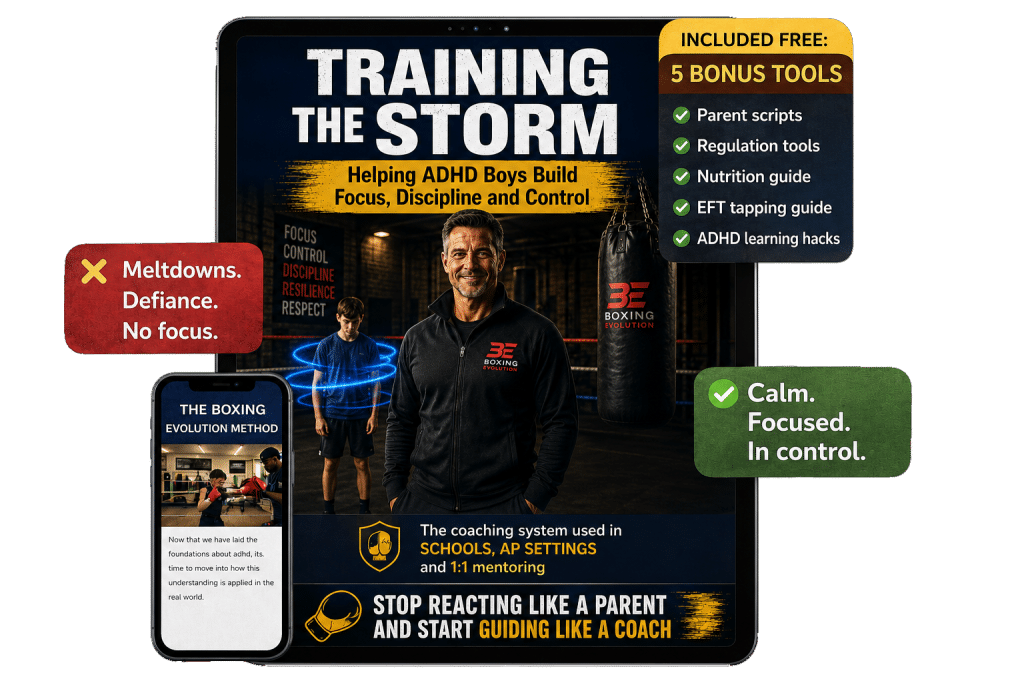
Both Mum and Dad were also provided with a copy of Training the Storm, Boxing Evolution’s parenting guide, to support their understanding of emotional regulation, communication, boundaries and the wider coaching approach being used with J.
Referral to Specialist Non-Violent Resistance Support
As the intervention progressed, Boxing Evolution recognised that the child-to-parent abuse component required specialist family support and should not become the responsibility of the alternative provision practitioner.
Mum and Dad were therefore signposted to a specialist charity providing Non-Violent Resistance (NVR) support.
NVR is an approach that supports parents and carers in responding to challenging, aggressive or controlling behaviours through strategies including parental presence, de-escalation, consistent boundaries and the development of supportive networks.
This represented an important progression in the intervention.
Boxing Evolution could continue supporting J’s emotional regulation, decision-making and individual development, while specialist practitioners supported Mum and Dad with the wider family dynamics.
Developing a Parental Coalition
At the final placement review, Mum and Dad reported that their NVR work had enabled them to develop what they described as a parental “coalition.”
Rather than responding individually to incidents or adopting conflicting approaches, they were increasingly working together and maintaining a shared parental position.
They reported that the introduction of new boundaries initially resulted in an increase in challenging behaviour from J before his behaviour subsequently began to settle.
This pattern was consistent with what is sometimes described in behavioural psychology as an extinction burst, where an established behaviour may temporarily intensify when the responses that previously maintained it change.
By the final review, Mum and Dad reported that J had become calmer and that they were increasingly able to maintain their own boundaries without becoming drawn into repeated conflict.
How To Transform Your Challenging ADHD son into a focussed calm kid... without harsh discipline or relying solely on medication

TRAINING THE STORM
A Powerful Boxing-Based ADHD Parenting Guide
Inside the guide you will discover:
- How sports coaching principles transform parenting — Apply leadership, structure and skill development instead of constantly reacting to behaviour..
- The unconscious ways parents surrender leadership authority — Discover the everyday patterns that accidentally put your child in control of the dynamic.
- Why emotional regulation is the real battleground in ADHD — Understand what drives meltdowns, defiance and seemingly irrational behaviour.
- How to train emotional regulation — Practical coaching tools to help your child handle frustration, setbacks and strong emotions.
- How to set boundaries without becoming harsh or controlling — Lead with calm authority while reducing arguments, negotiation and power struggles.
- What to do in the moment when things kick off — Simple strategies and scripts for responding without getting dragged into the chaos.
- Why consequences alone often fail with ADHD — Learn when behaviour needs correcting and when the underlying skill needs developing.
- And much, much more — From school and nutrition strategies to communication, emotional regulation and practical tools for everyday ADHD life.
If you’re tired of “quick fixes”, constant battles and parenting advice that doesn’t seem to work with ADHD, then Training the Storm gives you a different approach.
STOP REACTING LIKE A PARENT AND START GUIDING LIKE A COACH
Think of Training the Storm as your parenting coaching blueprint: helping you understand what drives ADHD behaviour, reclaim your leadership role, and apply proven coaching principles to develop emotional regulation, focus, resilience and self-control.
Moving Away From a Household Organised Around Behaviour
One particularly significant change described by Mum was that NVR had helped them move away from organising family life around J’s behaviour.
Rather than repeatedly confronting J, blaming him or attempting to control every aspect of his behaviour, Mum and Dad were learning to maintain their own routines and calmly communicate the practical consequences of what had occurred.
For example, if J returning home late disrupted their sleep, rather than entering into an argument the following morning, they might explain that they now needed to complete a task they had been unable to undertake earlier because they were tired.
The emphasis shifted away from attempting to control J’s behaviour directly and towards Mum and Dad controlling their own responses, maintaining their own boundaries and continuing with their own lives.
This reduced the extent to which the functioning of the household revolved around J’s behaviour.
The parents’ account of these changes provided further support for the earlier assessment that sustainable progress required intervention not only with J individually, but also with the environment and relationships surrounding him.
Supporting Educational Re-engagement Through Functional Skills Tutoring
Following the breakdown of J’s relationship with his initial tutor, Boxing Evolution stepped in to provide interim Functional Skills tutoring while arrangements were being made for a new formal tutoring placement.
This ensured continuity of educational support while providing an opportunity to identify and address some of the underlying barriers to J’s engagement with learning.
Rather than viewing difficulties with learning solely as a lack of motivation or willingness to participate, Boxing Evolution explored the relationship between J’s emotional responses, the demands of educational tasks and his ability to remain engaged when experiencing difficulty.
Where aspects of learning triggered frustration or emotional dysregulation, J was supported in recognising these responses and developing practical coping mechanisms to manage them more effectively.
The objective was to help J remain engaged with learning rather than allowing emotional discomfort or frustration to result in avoidance or withdrawal.
This enabled principles already being developed through boxing — including frustration tolerance, emotional regulation, perseverance and responding constructively to challenge — to be applied within an educational context.
The interim tutoring therefore served several purposes:
Maintaining educational engagement while formal tutoring arrangements were being established.
Identifying specific emotional and behavioural barriers to learning.
Developing practical coping mechanisms to manage educational demands.
Supporting the transfer of emotional regulation skills from physical training into academic activities.
Preparing J for engagement with a dedicated educational tutor.
Once formal tutoring provision was established, Boxing Evolution was able to return its focus to J’s wider emotional, behavioural and personal development.
This represented another example of the intervention responding flexibly to an identified need while supporting progression towards appropriate specialist provision, rather than attempting to replace it indefinitely.
Multi-Agency Working and Wider Educational Re-engagement
Throughout the placement, Boxing Evolution maintained communication with the wider professional network and contributed observations regarding J’s engagement, emotional regulation, behaviour and response to intervention.
A significant feature of the placement was that J’s engagement with Boxing Evolution was followed by increasing engagement with other forms of support.
By the final review, J was engaging with a wider network of interventions, including:
Educational tutoring.
Alternative provision.
Mentoring.
Counselling and therapeutic support.
Outdoor and activity-based provision.
Mum and Dad were also engaging with specialist professional support and implementing NVR strategies within the home.
J received particularly positive feedback from his outdoor provision, which appeared to contribute positively to his confidence and self-esteem.
This wider engagement represented an important change from the position at the beginning of the intervention, when establishing engagement itself had been a major challenge.
Boxing Evolution did not need to deliver every component of J’s support package. Its contribution included helping establish the engagement, confidence and developmental foundations upon which other interventions could build.
Challenges During the Intervention
Progress was not linear.
There continued to be periods of non-engagement, disrupted sleep, difficulty maintaining routines, impulsive responses to messages and peer situations, and inconsistent motivation towards formal learning.
There were occasions when J did not attend planned sessions or was unable to engage because he had remained awake late into the night.
Peer relationships and situations occurring within the community periodically resulted in heightened emotional responses.
These difficulties were not automatically regarded as evidence that the intervention was failing. Instead, where appropriate, incidents were used as opportunities to identify behavioural patterns and develop practical regulation and decision-making strategies.
Towards the latter stages of the intervention, it also became increasingly apparent that some of the remaining barriers required changes within the home and consistent implementation by Mum and Dad, rather than increased direct intervention from Boxing Evolution.
Recognising this distinction was important in ensuring that professional support remained appropriately targeted.
Final Review and Reported Outcomes
At the final placement review, Mum and Dad reported the following changes:
| Developmental area | Parent-reported outcome |
|---|---|
| Behaviour | Significant improvement |
| Emotional regulation | Significant improvement |
| Confidence | Significant improvement |
| School and learning engagement | Some improvement |
| Motivation | Some improvement |
When asked to describe the positive changes they had observed, Mum and Dad specifically identified improvements in:
“Self-esteem; self-worth and self-belief.”
The principal ongoing concern identified at review was:
“Motivation and engagement in learning.”
This distinction is important.
The intervention did not result in the resolution of every area of difficulty. However, substantial progress was reported in several of the developmental areas that had originally presented significant barriers to engagement.
The outcomes also extended beyond J’s individual development.
Wider Outcomes
| Area | Progression |
|---|---|
| Initial engagement | Progression from reluctance to leave the home towards participation in multiple interventions |
| Professional relationships | Increased willingness to engage with wider support |
| Family dynamics | Parents accessing specialist NVR support |
| Parental consistency | Development of a shared parental coalition |
| Household boundaries | Parents reporting greater consistency and reduced reactivity |
| Specialist intervention | Identification of needs and referral beyond the remit of alternative provision |
| Placement transition | Mutually agreed ending following positive progress |
A Planned and Positive Ending
Following review with Mum and Dad, it was mutually agreed that the regular Boxing Evolution intervention would conclude.
This was a planned ending following positive progress, rather than termination resulting from placement breakdown.
By this stage, J had developed engagement with a wider network of provision, while Mum and Dad had begun accessing specialist NVR support and were reporting positive changes within the family home.
The areas requiring the greatest ongoing attention had increasingly shifted towards:
Maintaining consistent home routines.
Embedding parental boundaries and NVR strategies.
Sustaining engagement with wider provision.
Developing motivation towards formal learning.
It was therefore considered appropriate for these supports to continue without creating unnecessary dependence on the Boxing Evolution intervention.
An effective intervention should not necessarily be measured by how long a young person remains within it, but also by whether it enables the young person to progress beyond it.
About Boxing Evolution Alternative Provision
Boxing Evolution AP provides relationship-based, activity-led alternative provision for young people experiencing social, emotional and mental health (SEMH) difficulties, SEND-related barriers, educational disengagement and challenges accessing mainstream education.
Through boxing, physical training, mentoring and performance psychology, Boxing Evolution supports young people in developing the emotional, behavioural and personal skills required to engage more effectively with education and everyday life.
The provision works collaboratively with schools, local authorities, families and other professionals to support individual development, identify barriers to progression and contribute to wider educational outcomes.
For referral enquiries, commissioning information or to discuss how Boxing Evolution could support a young person, please contact Boxing Evolution directly.
ADHD Parent Support Library
Explore our articles, insights and practical strategies for supporting children with ADHD. Choose a section below to find the topics most relevant to you and your child.

DOWNLOAD THE FREE PDF BY REGISTERING BELOW.