
ADHD
ADHD on the Rise in Britain: What’s Really Going On?

Following the recent announcement by Wes Streeting to launch a national review into ADHD diagnoses and support services, ADHD has once again become a highly charged topic in Britain. Headlines question whether ADHD is being over diagnosed, while families facing multi-year waiting lists argue that the system is failing to recognise genuine need.

First allow me to introduce myself. I’m Matt Flavell, the founder of Boxing Evolution Ltd, where for over 15 years, I’ve dedicated myself to reshaping 1000’s of people’s lives helping them reach their full potential, through the power of boxing, underpinned by teaching the psychology of success and mentorship.
Some commentators argue that greater awareness and waiting-list pressures reflect underdiagnosis and unmet need, while others suggest that behavioural and emotional distress are being medicalised.
But the real issue is rarely discussed clearly.
Many of the behaviours now being labelled as ADHD can come from very different causes — and those causes require very different solutions.
To understand what is really going on, we must clearly separate ADHD, Adverse Childhood Experiences (ACEs), and non-ACE environmental factors. While these can overlap in symptoms, they are not the same — and confusing them leads to poor outcomes for children.
What ADHD Is – and What It Is Not
ADHD is a neurodevelopmental condition that primarily affects executive functioning.
It involves biological differences in how the brain regulates:
Attention (sustaining focus, filtering distractions, task initiation)
Impulse control (thinking before acting, inhibiting reactions)
Activity and arousal levels (hyperactivity or internal restlessness)
Many individuals with ADHD also experience difficulties with emotional regulation, as well as co-occurring traits or conditions such as anxiety, sensory sensitivities, learning differences, or sleep issues. These are common but are not formally included in the diagnostic criteria.
For a diagnosis of combined-type ADHD, all three core domains — attention regulation, impulse control, and hyperactivity — must be present.
What was historically referred to as ADD is now classified as ADHD, predominantly inattentive type, where hyperactivity is minimal or absent.
ADHD is biological, real, and not caused by poor parenting, trauma, or lack of discipline.
It is typically evident from early childhood, although its impact often becomes more noticeable when environmental demands — such as school — exceed the child’s executive functioning capacity.
At the same time, not every child who looks like they have ADHD actually does. This distinction matters.
ADHD vs ACEs: How symptoms overlap
Adverse Childhood Experiences (ACEs) are stressful or traumatic experiences that disrupt a child’s sense of safety and nervous system regulation during development.
The recognised ACEs include:
physical abuse
emotional abuse
sexual abuse
physical neglect
emotional neglect
parental separation or divorce
domestic violence in the household
substance misuse by a parent
mental illness in a parent
parental incarceration
Each of these increases stress on a developing nervous system. But one factor consistently stands out in modern childhood:
The Broken Home and Chronic Parental Conflict
Parental separation and divorce — particularly when combined with ongoing conflict — are now among the most common ACEs children experience.
It is often not the separation itself that causes harm, but:
prolonged tension between parents
inconsistent rules between households
emotional instability
lack of predictable structure
children being caught in the middle
For a child, this creates persistent background stress.
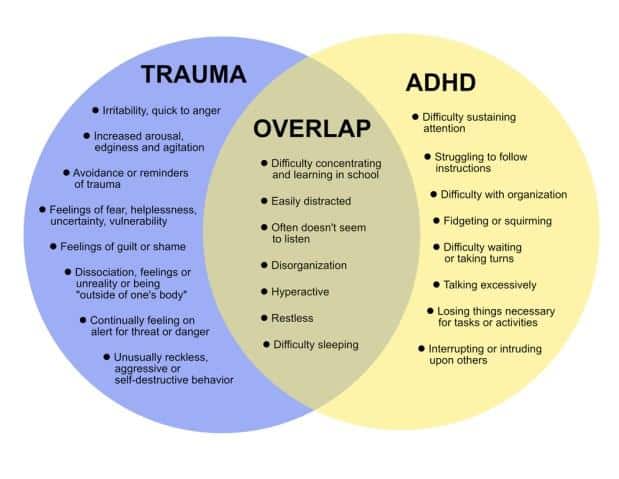
#Key take away: Many of the symptoms of ADHD can actually be caused by ACE’s.
Research from the National Child Traumatic Stress Network shows there is an overlap between ADHD and Adverse Childhood Experiences. Read the full study here.
How To Transform Your Challenging ADHD son into a focussed calm kid... without harsh discipline or relying solely on medication
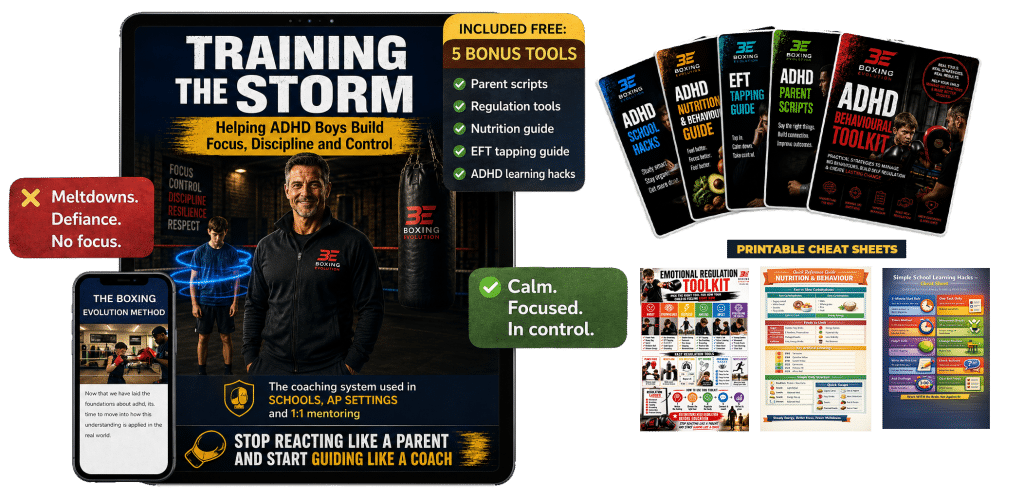
TRAINING THE STORM
A Powerful Boxing-Based ADHD Parenting Guide
Inside the guide you will discover:
- How sports coaching principles transform parenting — Apply leadership, structure and skill development instead of constantly reacting to behaviour..
- The unconscious ways parents surrender leadership authority — Discover the everyday patterns that accidentally put your child in control of the dynamic.
- Why emotional regulation is the real battleground in ADHD — Understand what drives meltdowns, defiance and seemingly irrational behaviour.
- How to train emotional regulation — Practical coaching tools to help your child handle frustration, setbacks and strong emotions.
- How to set boundaries without becoming harsh or controlling — Lead with calm authority while reducing arguments, negotiation and power struggles.
- What to do in the moment when things kick off — Simple strategies and scripts for responding without getting dragged into the chaos.
- Why consequences alone often fail with ADHD — Learn when behaviour needs correcting and when the underlying skill needs developing.
- And much, much more — From school and nutrition strategies to communication, emotional regulation and practical tools for everyday ADHD life.
If you’re tired of “quick fixes”, constant battles and parenting advice that doesn’t seem to work with ADHD, then Training the Storm gives you a different approach.
STOP REACTING LIKE A PARENT AND START GUIDING LIKE A COACH
Think of Training the Storm as your parenting coaching blueprint: helping you understand what drives ADHD behaviour, reclaim your leadership role, and apply proven coaching principles to develop emotional regulation, focus, resilience and self-control.
Why ACEs Can Look Exactly Like ADHD
When a child grows up under chronic stress, their brain prioritises survival over learning.
This can result in:
poor concentration
impulsivity
emotional volatility
difficulty following instructions
hyperactivity or withdrawal
low frustration tolerance
Neurologically, this affects the same executive systems involved in ADHD.
👉 This does not mean ADHD isn’t real.
👉 It means trauma can mimic ADHD extremely closely.
Some children have ADHD.
Some have ACE-related dysregulation.
Some have both.
Treating all three as the same problem is where systems fail.
Non-ACE Factors Commonly Mislabelled as ADHD
Not all ADHD-like behaviour comes from trauma. There are also non-ACE environmental factors that significantly affect regulation but are often ignored.
These are not traumatic — but they are highly dysregulating.
Sleep Deprivation
Inconsistent or insufficient sleep impairs attention, emotional regulation, and impulse control. A chronically overtired child can present almost identically to a child with ADHD.
Nutrition and Blood Sugar Instability
High sugar intake, poor breakfast habits, and erratic eating patterns lead to energy crashes, irritability, and attention difficulties.
Screen Time and Dopamine Overload
Excessive screen use conditions the brain to constant novelty and instant reward. When children then face slower, effort-based tasks, the brain resists — producing boredom, restlessness, and impulsivity that are often mistaken for ADHD.
Screens do not cause ADHD, but they can magnify or mimic symptoms.
Why Boys Are Often the Ones Flagged
Boys typically express dysregulation physically.
They tend to have:
higher baseline energy
stronger need for movement
lower tolerance for prolonged sitting
Without appropriate outlets, this energy becomes disruption, confrontation, and impulsive behaviour — frequently mislabelled as ADHD.
Addressing Foundations Before Labels
When ADHD, ACEs, and environmental factors overlap, the most effective approach is to address fundamentals first:
consistent sleep routines
stable nutrition
reduced screen exposure
calm, predictable parental leadership
daily energy-burning physical activity
For many children, these changes alone significantly reduce symptoms. For those with genuine ADHD, they make medication and therapy far more effective.
How Boxing Evolution Supports Regulation Beyond Medication
At Boxing Evolution, we work with young people labelled as ADHD, excluded from school, or struggling with emotional regulation and makes up much of the core work we do with our Alternate Provision.
Boxing provides:
structured physical output
clear boundaries and expectations
nervous system regulation through movement
confidence built through mastery
focus developed under controlled intensity
For many students, once sleep, routine, screens, leadership, and movement are addressed, behaviour improves dramatically — sometimes reducing the need for medication, and often improving its effectiveness when used.
Learn more about how Boxing training helps with ADHD by clicking here.
Lorem ipsum dolor sit amet, consectetur adipiscing elit. Ut elit tellus, luctus nec ullamcorper mattis, pulvinar dapibus leo.
Final thought
The question isn’t whether ADHD is rising.
The real question is:
How many children are dysregulated — and why?
Until we clearly distinguish between ADHD, ACEs, and environmental factors, we will continue to label symptoms rather than solve problems.
If you enjoyed this article, please check out the one below.
Get Your FREE Intro to online boxing coaching.
Complete with animated video guidance.

DOWNLOAD THE FREE PDF BY REGISTERING BELOW.
WANT TO GET FIT AND LOSE WEIGHT BUT DON'T KNOW WHERE TO START?
Check out our 5 day 1000 punch free challenge. Filled with lots of fitness, mindset and nutrition tips that can be implemented straight away making get started with your transformation journey simple and easy!

5 reasons your mindset is killing your potential
LEARN ABOUT THE HIDDEN MENTAL BLOCKS HOLDING YOU BACK!

DOWNLOAD THE FREE PDF BY REGISTERING BELOW.
