ADHD
Did the Government Report Really Say ADHD Is Underdiagnosed?
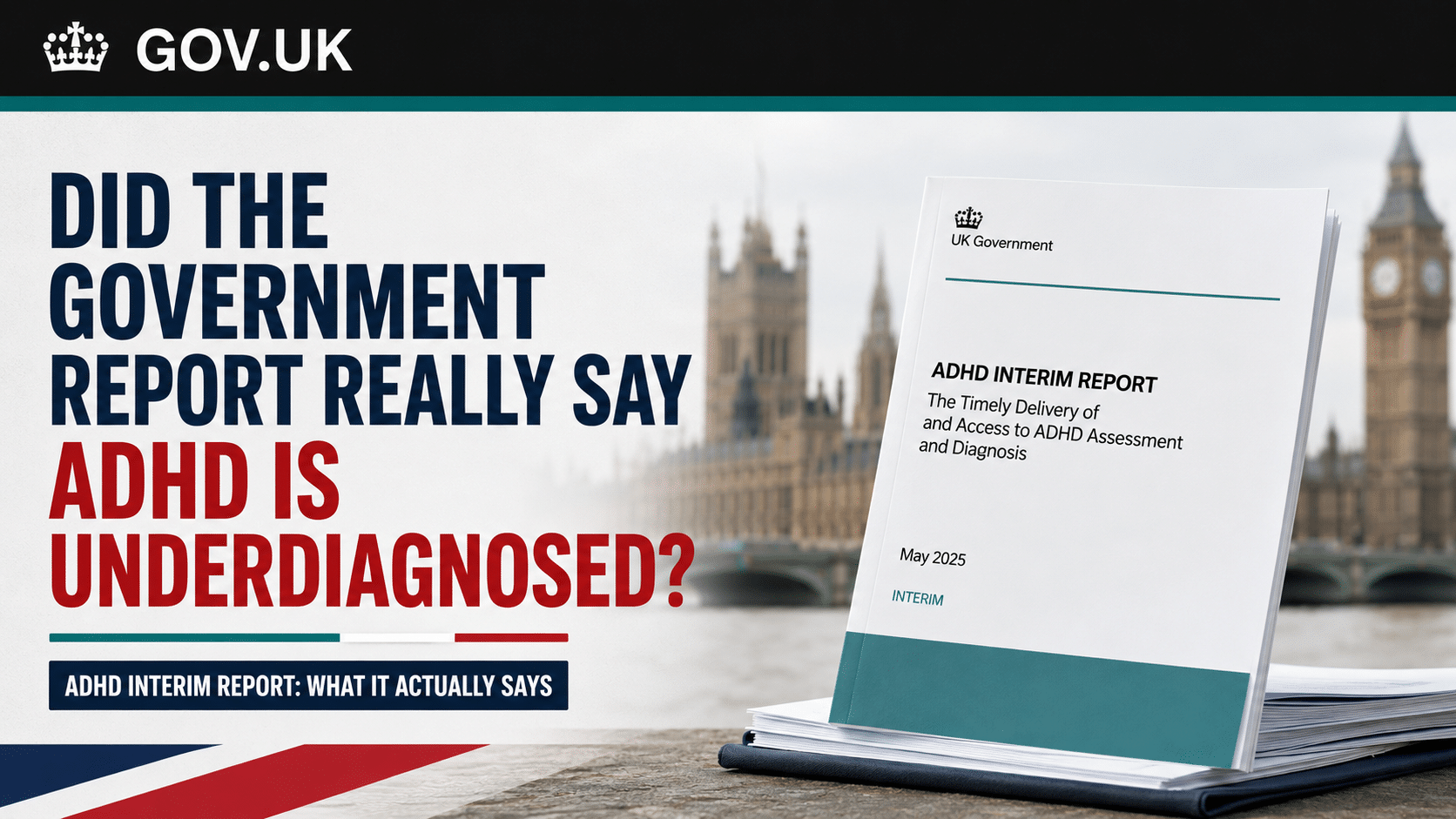
Since the publication of the government’s independent interim review into mental health conditions, ADHD and autism, claims have circulated on TikTok that the report found ADHD is underdiagnosed. It is also something that has been highlighted since Channel 4’s controversial documentary ‘The Great ADHD Myth’ aired, so lets examine it further.
That claim is based on something contained within the report, but it leaves out important context. The report does not reach the simple conclusion that ADHD is underdiagnosed across the population.
Instead, it says that continued underdiagnosis is one possible interpretation of the available evidence—and immediately identifies the assumptions and uncertainties behind that interpretation.

First allow me to introduce myself. I’m Matt Flavell, the founder of Boxing Evolution Ltd, where for over 15 years, I’ve dedicated myself to reshaping 1000’s of people’s lives helping them reach their full potential, through the power of boxing, underpinned by teaching the psychology of success and mentorship.
Why are people claiming the report found underdiagnosis?
The report compares the number of people with a recorded ADHD diagnosis against commonly accepted estimates of ADHD prevalence.
NICE currently cites estimates of ADHD affecting approximately 5% of children and young people and between 2% and 3% of adults. Recorded diagnoses remain below these estimated levels across much of the population, particularly among older adults.
The report also refers to evidence from the Adult Psychiatric Morbidity Survey. It found that almost everyone who reported having received a professional ADHD diagnosis screened positive on the Adult ADHD Self-Report Scale. At the same time, only a minority of those who screened positive reported having received a diagnosis, treatment or identifying themselves as having ADHD.
The report says this pattern is consistent with diagnosis and treatment being concentrated among those with higher levels of symptoms while some potentially affected people remain unidentified or unsupported.
It then states that:
“One interpretation of the current position is therefore that it involves continued underdiagnosis across the life course, especially in older adults, alongside rapid recent expansion in diagnosis among younger groups.”
This is the part now being used to claim that the government report concluded ADHD is underdiagnosed.
However, the words “one interpretation” are important.
The conclusion depends on accepting the prevalence estimates
Immediately after presenting underdiagnosis as one possible interpretation, the report adds an important qualification:
“That interpretation does, however, depend on accepting the epidemiological benchmarks as the appropriate comparator, and that assumption itself warrants some caution.”
In simple terms, the argument for underdiagnosis works like this: if research estimates that between 2% and 3% of adults have ADHD, but fewer than that have received a recorded diagnosis, the difference could represent people whose ADHD has not been identified.
However, that conclusion depends upon the prevalence estimate being an accurate measure of how many people genuinely meet the full diagnostic criteria.
The report acknowledges that this remains uncertain. It explains that England does not currently have a recent, large-scale diagnostic survey of ADHD within a representative adult population. Much of the available adult evidence comes from screening tools or administrative diagnosis data, neither of which provides a complete substitute for a full population-based diagnostic assessment.
A screening tool can identify people who report traits associated with ADHD, but screening positive is not the same as receiving a comprehensive diagnosis. A diagnosis also requires evidence that symptoms began during childhood, occur across more than one setting and cause clinically significant functional impairment.
The prevalence estimates are therefore useful, but the report does not treat them as unquestionably correct.
#Key take away: The claim that the government report proved ADHD is underdiagnosed is missing essential context.
The Independent Review into Mental Health Conditions, ADHD and Autism. Read the full study here.
Recorded diagnosis and underlying prevalence are not the same thing
One of the report’s central messages is that population prevalence, recorded diagnosis and demand for assessment must not be treated as interchangeable.
Population prevalence concerns the estimated proportion of people who meet the criteria for ADHD, whether or not they have approached a service.
Administrative prevalence refers to the number of people whose diagnosis has been formally recorded within systems such as primary care.
Service demand refers to the number of people seeking help, being referred or waiting for assessment.
These measures can move in different directions and at different speeds.
The report found that recorded ADHD diagnoses, referrals and waiting lists have risen substantially, particularly since 2020. The number of children and young people waiting for an ADHD assessment reportedly increased from approximately 21,000 in April 2019 to around 270,000 by December 2025.
However, the population evidence reviewed does not indicate that the underlying prevalence of ADHD has increased at anything close to the same rate. The report describes estimated prevalence as comparatively stable.
This means rising referrals cannot automatically be interpreted as proof that ADHD itself has become dramatically more common. Equally, the gap between estimated prevalence and recorded diagnosis cannot automatically be treated as definitive proof of underdiagnosis.
Why might demand for diagnosis be increasing?
The report identifies several processes that may be contributing simultaneously.
These include improved recognition of previously unidentified ADHD, greater public awareness, changing help-seeking behaviour and reduced stigma. These developments may have allowed people who were previously overlooked to understand their difficulties and seek appropriate assessment.
However, the report also considers the influence of increasing psychological distress, educational pressures, digital environments, changing social expectations and the institutional importance of diagnosis.
This last point is especially important. In many settings, diagnosis has become the practical gateway to support, adjustments and formal recognition.
Although the Equality Act 2010 is based upon substantial and long-term impairment rather than the possession of a particular diagnosis, the report notes that institutions frequently rely upon diagnostic documentation as evidence that support is justified.
This is particularly relevant within education, higher education and employment. If support is difficult to access without a recognised diagnosis, people experiencing genuine difficulties have a strong incentive to enter a diagnostic pathway.
The report therefore suggests that systems are not merely responding to diagnostic demand. The way those systems allocate support may also be helping to create that demand.
This does not mean people are inventing their difficulties to obtain a diagnosis. It means that people may be directed towards medical assessment because diagnosis has become the most dependable route to having their difficulties recognised.
What does the report say about overdiagnosis?
The report does not conclude that ADHD is being widely overdiagnosed either.
It uses “overdiagnosis” to describe situations in which a diagnosis may be applied even though the level of difficulty or impairment may not require a formal clinical label, or where the label does not provide a clear additional benefit in deciding what support is appropriate.
The report explicitly says that this does not mean the person’s experiences or difficulties are unreal. Instead, it raises the possibility that a medical label may not always be the most helpful or proportionate way of understanding and responding to those difficulties.
The report also distinguishes this from misdiagnosis, where a genuine difficulty is recognised but attributed to the wrong condition.
Its position is that underdiagnosis, misdiagnosis and overdiagnosis are not mutually exclusive. Different problems could be occurring among different groups within the same system.
Some people with clinically significant ADHD may remain unidentified. Some people’s difficulties may be attributed to ADHD when another explanation would be more accurate. Other people may have genuine difficulties for which a formal diagnosis provides little additional benefit.
The missing information: functional impairment
The report says one of the most important unresolved questions is whether the severity and functional impact associated with ADHD diagnosis have changed over time.
Diagnoses and referrals have increased sharply, but routine data does not reliably show whether people now receiving diagnoses are, on average, more impaired, less impaired or differently impaired than people diagnosed previously.
Without this information, the review cannot determine whether diagnostic thresholds have changed significantly.
This is why neither a confident underdiagnosis claim nor a confident overdiagnosis claim is currently justified by the report.
To establish underdiagnosis more firmly, researchers would need stronger evidence that significant numbers of people meet the full diagnostic criteria, experience clinically meaningful impairment and remain unidentified.
To establish overdiagnosis, they would need evidence that diagnoses are increasingly being given where the level of impairment does not justify a clinical label or where the diagnosis does not help guide appropriate support.
The report says the available national data is not yet sufficient to settle these questions.
What is the report’s actual position?
The report’s position is not that ADHD is simply underdiagnosed or overdiagnosed.
It finds that recorded diagnoses remain below commonly cited prevalence estimates, which is consistent with some continuing underdiagnosis. However, it warns that this interpretation depends upon treating those prevalence estimates as the correct benchmark, despite important limitations in the available adult evidence.
At the same time, the report finds that diagnoses and referrals are rising much faster than estimated underlying prevalence. It identifies improved recognition, increased distress, changing help-seeking, educational and social pressures, and diagnosis-linked access to support as possible contributors.
It also acknowledges the possibility of misdiagnosis, overdiagnosis and the medicalisation of difficulties that may have broader social, psychological or environmental roots.
Most importantly, it admits that the system does not collect enough reliable information about severity and functional impairment to determine whether diagnostic thresholds have changed.
How To Transform Your Challenging ADHD son into a focussed calm kid... without harsh discipline or relying solely on medication
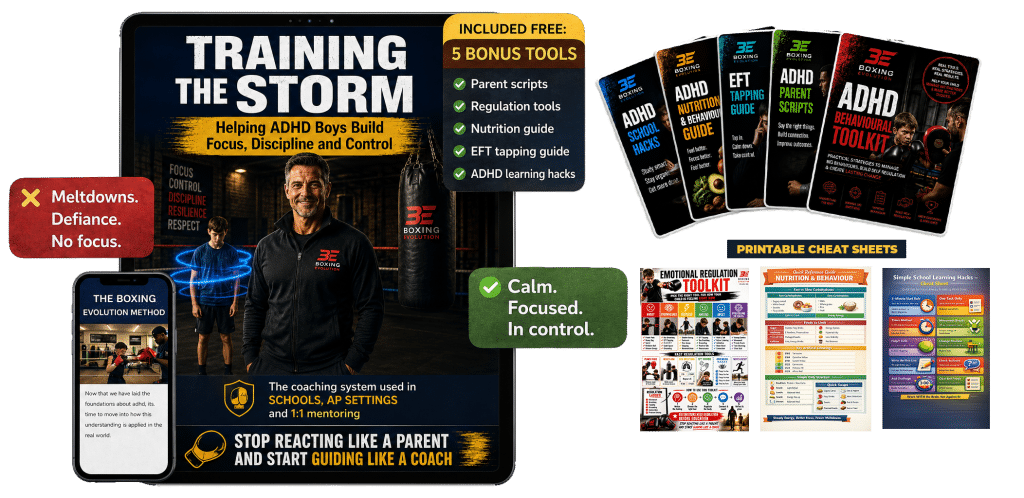
TRAINING THE STORM
A Powerful Boxing-Based ADHD Parenting Guide
Inside the guide you will discover:
- How sports coaching principles transform parenting — Apply leadership, structure and skill development instead of constantly reacting to behaviour..
- The unconscious ways parents surrender leadership authority — Discover the everyday patterns that accidentally put your child in control of the dynamic.
- Why emotional regulation is the real battleground in ADHD — Understand what drives meltdowns, defiance and seemingly irrational behaviour.
- How to train emotional regulation — Practical coaching tools to help your child handle frustration, setbacks and strong emotions.
- How to set boundaries without becoming harsh or controlling — Lead with calm authority while reducing arguments, negotiation and power struggles.
- What to do in the moment when things kick off — Simple strategies and scripts for responding without getting dragged into the chaos.
- Why consequences alone often fail with ADHD — Learn when behaviour needs correcting and when the underlying skill needs developing.
- And much, much more — From school and nutrition strategies to communication, emotional regulation and practical tools for everyday ADHD life.
If you’re tired of “quick fixes”, constant battles and parenting advice that doesn’t seem to work with ADHD, then Training the Storm gives you a different approach.
STOP REACTING LIKE A PARENT AND START GUIDING LIKE A COACH
Think of Training the Storm as your parenting coaching blueprint: helping you understand what drives ADHD behaviour, reclaim your leadership role, and apply proven coaching principles to develop emotional regulation, focus, resilience and self-control.
Support should not depend entirely on diagnosis
The report suggests that one reason ADHD referrals and diagnoses have risen so dramatically is that diagnosis has become the main pathway through which children and families can access support. When schools and other services require a formal label before responding to a child’s needs, seeking diagnosis becomes the logical—and sometimes only—option.
This creates a system in which families can spend months or even years waiting for an assessment before meaningful support begins. Yet many of the difficulties that led them to seek help, including emotional dysregulation, impulsive behaviour, frustration and conflict at home, already require a practical response.
There is a great deal that parents can begin doing while their child is waiting for an assessment. A diagnosis is not required to start improving routines, strengthening boundaries, understanding patterns of emotional activation or teaching a child how to respond more effectively when overwhelmed.
The same remains true after a diagnosis has been given. A diagnosis can provide an explanation, guide appropriate treatment and open the door to additional support, but it does not automatically develop the skills a child needs to manage emotions, cope with frustration or recover from setbacks.
This is one of the many reasons I created Training the Storm because it fits into the bigger picture.
It gives parents practical coaching strategies they can use before, during and after the diagnostic process.
The aim is not to replace assessment or treatment, but to ensure that support and skills development do not have to wait for a label—and do not stop once that label has been provided.
ADHD Parent Support Library
Explore our articles, insights and practical strategies for supporting children with ADHD. Choose a section below to find the topics most relevant to you and your child.
DOWNLOAD THE FREE PDF BY REGISTERING BELOW.