ADHD
ADHD Coaching Tip: The 5-Minute Rule, Momentum Stacking and the Eisenhower Matrix

Getting started can be one of the most difficult parts of completing a task when you have ADHD, or likewise if you’re a parent, getting your child to start will most likely be a challenge.
It may be understood exactly what needs to be done but finding the motivation to start is always a struggle.
With ADHD the main challenge is getting your brain to move from its natural daydream-like state (ADHD brains struggle with state change) into one that is ready to concentrate. Even after that, you can become stuck deciding where to begin, especially when several tasks or ideas are competing for your attention.
In order to do so I use these three methods which are ones I have regularly used when training fitness clients, but the same principles apply. I also successfully use these methods daily with the young people I work with through my Alternate Provision.
They are the Eisenhower Matrix, the 5-minute rule and what I call a momentum stack using an activation routine. I then connect this process to my training schedule through habit stacking and positive association. Each method addresses a different part of the problem.
The Eisenhower Matrix helps me decide what deserves my attention, the 5-minute rule reduces the resistance to beginning and the momentum stack helps me build enough activation to continue.

First allow me to introduce myself. I’m Matt Flavell, the founder of Boxing Evolution Ltd, where for over 15 years, I’ve dedicated myself to reshaping 1000’s of people’s lives helping them reach their full potential, through the power of boxing, underpinned by teaching the psychology of success and mentorship.
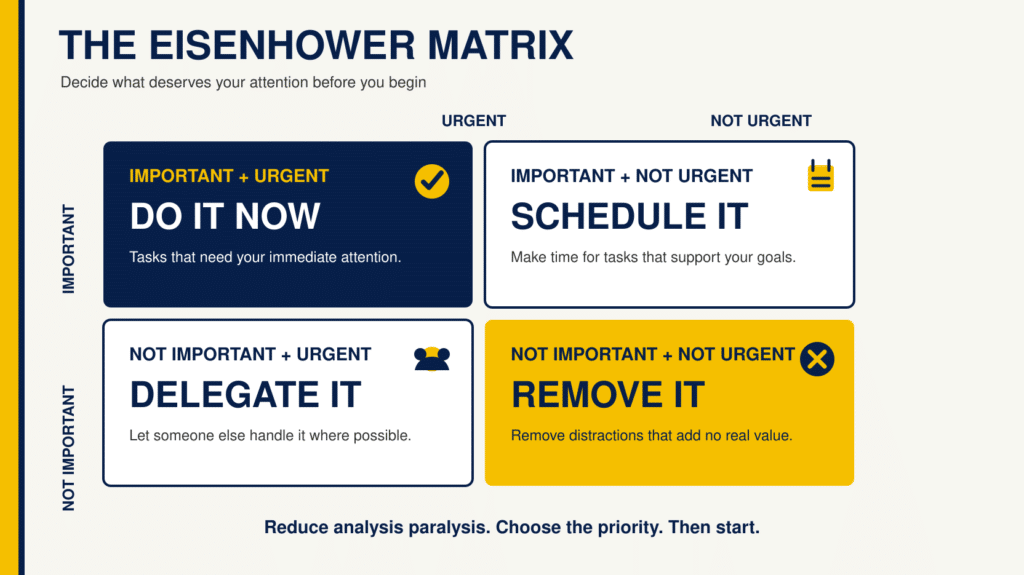
The Eisenhower Matrix: Removing Analysis Paralysis
Before I can start working, I need to know what I should be working on.
Prioritisation can be difficult when several tasks are competing for attention. They can all begin to feel equally important, or the most interesting and stimulating task can capture my attention even when it is not the one that matters most.
This creates analysis paralysis. I can spend more time thinking about what to do, moving between tasks or responding to whatever is immediately in front of me than I spend completing meaningful work.
The Eisenhower Matrix separates tasks according to their importance and urgency. Important and urgent tasks are completed first. Important but non-urgent tasks are scheduled. Urgent but less important tasks can be delegated where possible, while tasks that are neither important nor urgent can usually be removed or left until later.
Its value comes from reducing the number of decisions my brain needs to make. Instead of trying to hold an entire list of competing responsibilities in my head, I identify the task that currently deserves my attention.
Once I have chosen the task, however, I still need to start it.
The 5-Minute Rule: Reducing the Barrier to Starting
A large task can create resistance before I have even begun. My mind anticipates the time, effort and frustration involved, making the task feel heavier than it actually is.
The 5-minute rule changes the agreement I make with myself. Instead of telling myself that I must complete the entire task, I commit to doing it for just five minutes.
Five minutes feels manageable. I do not need to know how long the whole task will take, feel completely motivated or promise that I will finish it. I only need to open the document, begin the activity and stay with it for five minutes.
The purpose is not to deceive myself into working for hours. It is to separate starting from finishing.
Once I begin, the task usually feels less difficult than it did while I was avoiding it. My brain starts to engage, the uncertainty reduces and I create some forward movement. This is where the momentum stack begins.
#Key take away: Getting started with ADHD can be difficult because turning intention into action requires choosing a starting point and activating attention.
Momentum Stacking: Using One Action to Activate the Next
Momentum stacking is the term I use for arranging a sequence of small actions so that completing one makes it easier to begin the next.
Rather than attempting to move directly from inactivity into a long period of concentration, I create a series of achievable steps. I might prepare my workspace, choose the priority using the Eisenhower Matrix, open the relevant document, write the heading and work for five minutes.
None of these actions is particularly demanding by itself, but together they create momentum. Each step requires slightly less effort because I am no longer starting from zero.
This matters because motivation does not always arrive before action. Sometimes action has to come first. Motivation and concentration can then develop as the brain receives evidence that progress is being made.
The same principle can be used with children and young people. Telling a child to “do their homework” can create resistance because the instruction represents an entire task. Helping them choose one subject, put the book on the table and complete five minutes creates a more manageable entry point.
Momentum is built one achievable action at a time.
The Activation Routine - For Parents
Sometimes making a task smaller is not enough. A child may understand the first step but still struggle to begin because they have not yet shifted into a mental state that supports focused work. This is where an activating routine can be added before the momentum stack.
Physical activity can help increase alertness and prepare the brain for concentration. Rather than asking your child to move directly from resting, gaming or daydreaming into homework, try beginning with around ten minutes of enjoyable movement. Punch-pad work is particularly useful because it can combine physical activity with simple thinking challenges.
For example, while holding the pads, ask: “Throw the number of punches that five minus two equals.” Your child must process the question, calculate the answer and then respond with three punches. You can also use spelling, times tables, colours, memory sequences or instructions such as, “Jab, cross, hook, then tell me the capital of France.”
This combination of movement and thinking encourages your child to direct their attention externally while their level of mental and physical activation increases. The aim is not to exhaust them or make the activity highly competitive. It is to help them move out of an inactive or daydream-like state and towards a level of alertness that makes concentration more achievable.
Finish the activity with a short period of slower breathing and relaxation. This helps your child settle the physical excitement while remaining mentally alert. Give them a quick glass of water and then move directly into the first step of the momentum stack before that activation is lost.
Do not pause to discuss the whole workload or introduce several new decisions. Keep the transition simple: choose one subject, put the book on the table, open the correct page and begin five minutes of work.
With repetition, the activating routine can also become part of a habit stack. Completing the physical activity becomes the cue for beginning focused work. Your child begins to learn the sequence: activate the brain, centre the body and take the first manageable step.
The intensity may need to be adjusted for the individual child. If the activity leaves them overexcited or makes it more difficult to settle, shorten the session, reduce the intensity or allow slightly more time for breathing and relaxation. The goal is not maximum stimulation. It is finding the level of activation at which your child is most ready to engage.
Connecting Focused Work to My Training Routine
I strengthen this process by connecting focused work to something that already activates my brain: physical training.
Before going to the gym, I complete a short period of work while having an energy drink as my pre-workout. The caffeine provides stimulation and increases my alertness, while anticipating an activity I enjoy helps reduce my resistance to beginning. (Note this is relevant for adults not children)
After training, I often return to the task while my brain and body are still activated. Instead of attempting to concentrate from a low-energy, daydream-like state, I use the stimulation and momentum created by training.
This is a form of habit stacking. Preparing for the gym becomes a cue to begin working, while finishing my workout becomes a cue to return to it.
Repeating this sequence has also created a positive association. Work is no longer connected only with pressure, frustration or avoidance. It has become linked with training, energy, progress and achievement.
A 2026 review found that acute exercise improved inhibitory control and produced a smaller reduction in overall ADHD symptoms in adults. Xu et al. (2026). Read the full study here.
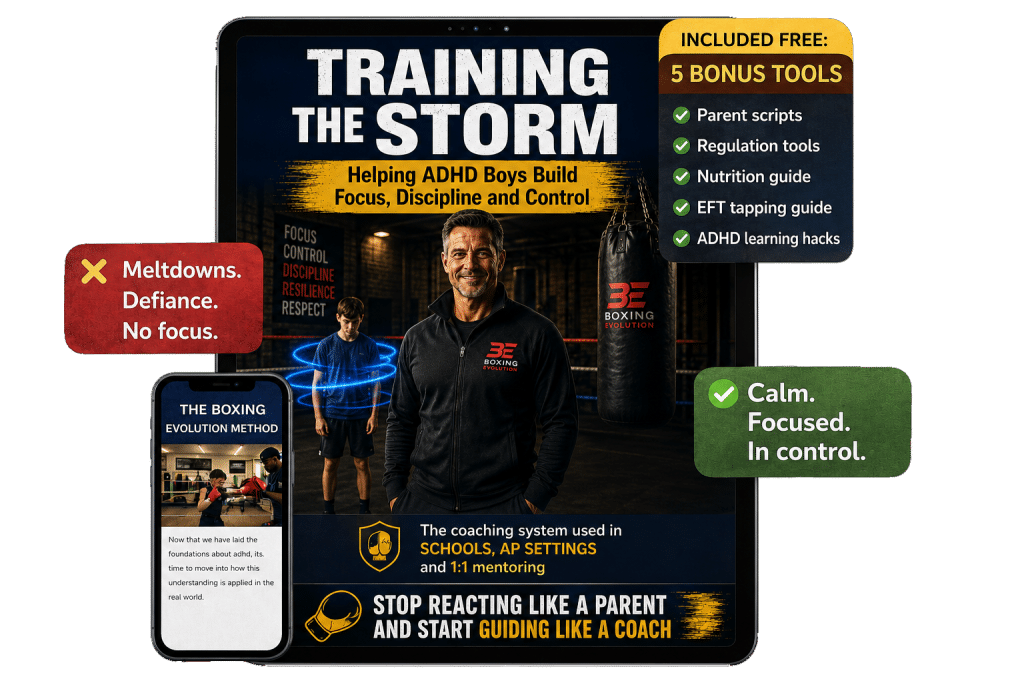
How To Transform Your Challenging ADHD son into a focussed calm kid... without harsh discipline or relying solely on medication
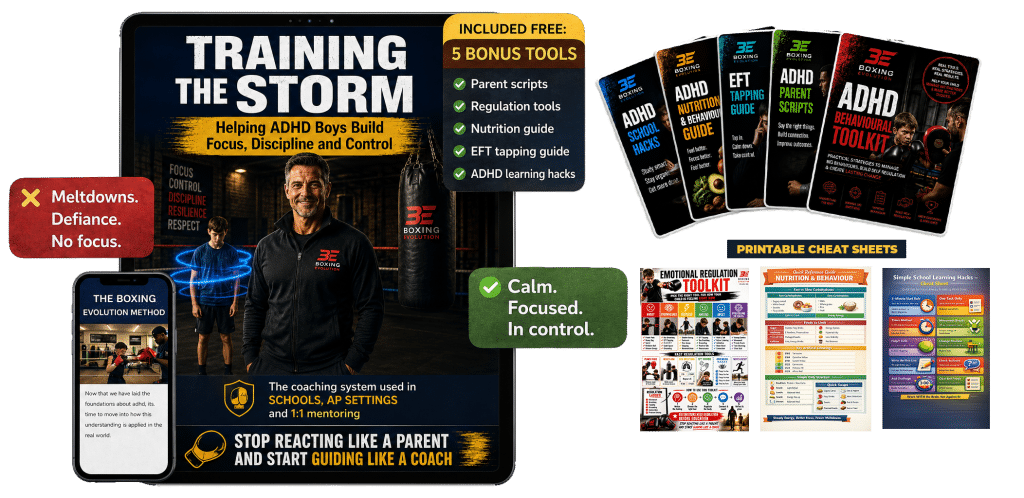
TRAINING THE STORM
A Powerful Boxing-Based ADHD Parenting Guide
Inside the guide you will discover:
- How sports coaching principles transform parenting — Apply leadership, structure and skill development instead of constantly reacting to behaviour..
- The unconscious ways parents surrender leadership authority — Discover the everyday patterns that accidentally put your child in control of the dynamic.
- Why emotional regulation is the real battleground in ADHD — Understand what drives meltdowns, defiance and seemingly irrational behaviour.
- How to train emotional regulation — Practical coaching tools to help your child handle frustration, setbacks and strong emotions.
- How to set boundaries without becoming harsh or controlling — Lead with calm authority while reducing arguments, negotiation and power struggles.
- What to do in the moment when things kick off — Simple strategies and scripts for responding without getting dragged into the chaos.
- Why consequences alone often fail with ADHD — Learn when behaviour needs correcting and when the underlying skill needs developing.
- And much, much more — From school and nutrition strategies to communication, emotional regulation and practical tools for everyday ADHD life.
If you’re tired of “quick fixes”, constant battles and parenting advice that doesn’t seem to work with ADHD, then Training the Storm gives you a different approach.
STOP REACTING LIKE A PARENT AND START GUIDING LIKE A COACH
Think of Training the Storm as your parenting coaching blueprint: helping you understand what drives ADHD behaviour, reclaim your leadership role, and apply proven coaching principles to develop emotional regulation, focus, resilience and self-control.
Where Caffeine Fits Into My Routine
I still use caffeine to stimulate my brain and support my energy for concentration and motivation, but have found this is something I have needed more since getting older.
Personally, I find using it strategically works better for me than taking ADHD medication every day. I also do not experience the same withdrawal or rebound symptoms that I experienced when taking medication daily.
That is my individual experience, not a suggestion that caffeine should replace prescribed ADHD treatment. Caffeine is also a stimulant and can affect sleep, anxiety, heart rate and blood pressure, but because I link it to my fitness routine its not something I am concerned about.
Regular use can cause tolerance and withdrawal symptoms of its own, so I make sure I limit how much I have.
Caffeine may increase my alertness, but it does not decide what deserves my attention or organise the work for me. The Eisenhower Matrix, 5-minute rule and momentum stack are what help me direct that stimulation towards something productive, because concentration is only one aspect of ADHD that causes a challenge with starting work.
Don’t Wait for Motivation—Build Momentum
These ADHD techniques for getting started work because they address different barriers in the correct order.
The Eisenhower Matrix reduces analysis paralysis and helps me choose the right task. The 5-minute rule gets me across the barrier to beginning. Momentum stacking turns that first action into continued progress, while connecting the process to my training routine helps me become activated and makes the system easier to repeat.
If you are struggling to begin, avoid trying to complete the entire task inside your head. Identify what matters most, reduce it to a manageable first action and commit to doing it for five minutes.
You do not always need to feel motivated before you act. Sometimes you need to act first and allow motivation to catch up.
ADHD Parent Support Library
Explore our articles, insights and practical strategies for supporting children with ADHD. Choose a section below to find the topics most relevant to you and your child.

DOWNLOAD THE FREE PDF BY REGISTERING BELOW.