ADHD
I SCORED IN THE TOP 3% OF THE COUNTRY BUT DIDN'T COMPLETE THE WORK - WHY?

Further to all the controversy surrounding Channel 4’s ‘The Great ADHD Myth’ I thought I would share this story to help bring some much needed clarity.
When I was at university, I underwent an educational psychology assessment to investigate the difficulties I was experiencing with concentration, organisation and completing my coursework.
(Ironically I was more fixated with running the University Boxing club, which is what got me into what I do now! Read about that after this as I think you will find it interesting.)
The assessment showed that my verbal comprehension was in the 97th percentile. In simple terms, this placed my verbal understanding and reasoning within approximately the top 3% of people in the country.
I could understand complex information, recognise connections between ideas and answer questions quickly. In examinations, I would often finish long before other students.
But when I had several weeks to complete a piece of coursework, I often didn’t do it.
That apparent contradiction reveals something important about ADHD and academic performance. Understanding a subject and independently producing the work required to demonstrate that understanding are not the same ability.

First allow me to introduce myself. I’m Matt Flavell, the founder of Boxing Evolution Ltd, where for over 15 years, I’ve dedicated myself to reshaping 1000’s of people’s lives helping them reach their full potential, through the power of boxing, underpinned by teaching the psychology of success and mentorship.
What did my ADHD assessment reveal?
The assesment I took was the Wechsler Adult Intelligence Scale-Third Edition (WAIS-III) which is a clinical assessment tool used by psychologists to measure cognitive ability and intelligence in individuals aged 16 to 89.
Rather than providing just a single “IQ score,” this comprehensive test breaks down human intelligence into distinct cognitive domains.
An individual’s final profile is divided into two primary categories: Verbal IQ (language-based reasoning and vocabulary) and Performance IQ (non-verbal problem solving and visual-spatial skills). Within these categories, the test measures four core indexes with a score of 50 being the average:
- Verbal Comprehension: The ability to understand, apply, and express language.
My Score 97th Pecentile - Working Memory: The capacity to hold and manipulate information in short-term memory.
My Score 73rd Pecentile - Perceptual Organisation: The skill to interpret visual data and solve non-verbal problems.
My Score 68th Pecentile - Processing Speed: The speed and accuracy with which a person processes visual symbols.
My Score 47th Pecentile
I also put through a handwriting and copying speed test where my score came back at the lowest 4% of the country.
The psychologist identified a statistically significant difference between my verbal comprehension and the other areas of my cognitive profile, with the largest difference appearing between verbal comprehension and processing speed.
However, saying that I had “slow processing speed” does not fully explain my experience.
My processing-speed score was actually around the population average. It was only low when compared with my exceptionally high verbal comprehension. The tasks also involved quickly scanning visual information, matching symbols and producing an accurate written or motor response.
That is different from measuring how quickly I can understand a question or develop an answer.
I could read an examination question, comprehend it and formulate an answer extremely quickly. The problem became much more apparent when I had to take all the ideas in my head and organise them into a coherent written assignment.
My assessment described this perfectly:
“He has a clear picture of ideas, but has difficulty putting them across, resulting in poor organisation of ideas.”
That sentence probably describes the most disabling part of my ADHD better than any general statement about having a short attention span.
I understood the coursework — I just couldn’t start it!
When people think about ADHD and academic performance, they often imagine a student who cannot concentrate long enough to understand what is being taught.
That was not my experience.
I could understand the subject. I could contribute to discussions, absorb information quickly and perform well when a task was clearly defined and immediately in front of me. But when I had to independently plan and complete an extended piece of coursework, I would experience a mental block, also known as ‘Analysis paralysis’.
This is because with ADHD I would have numerous ideas in my head, but due to having so many, I would have no clear sense of where to begin. I would think about different possible openings, different aspects involved and all the information I wanted to include. In short the verbal comprehension ability would overload my working memory and processing ability.
Instead of this helping me to write, the volume of ideas could prevent me from taking the first step.
I would then sit in front of the work without doing anything.
From the outside, this could easily look like laziness, procrastination or a lack of interest. But the problem was not that I didn’t care or didn’t understand what I needed to do. The problem was converting my understanding into an organised sequence of actions, that had drained me mentally before I even begun typing.
Coursework measures more than subject knowledge
Completing coursework requires far more than understanding the academic subject.
A student must decide where to start, identify the most important information, organise ideas into a logical sequence and break a distant deadline into manageable stages (not to mention be motivated without the urgency).
They must initiate the task without immediate prompting, sustain their effort, shift their attention between different parts of the assignment and monitor whether the finished work meets the required standard.
These are executive-function demands.
When all these abilities are bundled into a single grade, the final mark is not only measuring the student’s knowledge. It is also measuring their ability to independently regulate their attention, organise themselves and consistently produce the required evidence.
This was the problem I experienced during my HND in computing. I could understand computing, but I struggled to complete the coursework required to prove it.
The education system could record that I had failed to submit an assignment or complete a qualification. What it could not show was whether I had failed because I didn’t understand computing or because my ADHD affected the process through which I was expected to demonstrate that understanding.
These are not the same thing.
ADHD is not simply an inability to focus
My experience has also made me question the common description of ADHD as a lack of attention.
I can focus intensely. My greater difficulty is controlling where that attention goes, disengaging it from one target and deliberately moving it towards another.
Writing an assignment requires constant shifts in attention. You have to generate an idea, step back from it, decide whether it is relevant, work out where it belongs and then return to the wider structure of the argument. You must repeatedly move between planning, writing, reviewing and editing.
If my attention becomes stuck at one stage—or I cannot shift from thinking about the task to physically beginning it—the entire process can stop.
I noticed this particularly clearly when I later took ADHD medication. The medication did not give me knowledge or intelligence that I previously lacked. What it appeared to improve was my ability to deliberately redirect my attention.
I could disengage from one activity and move towards the task I had consciously decided to complete. The internal resistance involved in changing direction felt significantly reduced.
This is why I believe it is often more accurate to describe ADHD as a difficulty regulating and directing attention than simply a lack of attention.
What does science say about ADHD and academic performance?
My experience is consistent with research showing that intellectual ability does not automatically protect someone with ADHD from executive-function difficulties or academic underachievement.
A study by Biederman and colleagues examined executive-function deficits in adults with ADHD. The researchers found that executive-function difficulties were associated with lower academic achievement regardless of whether someone had ADHD. Adults who had both ADHD and measurable executive-function deficits experienced greater functional difficulties than those with ADHD alone.
The researchers concluded that executive-function deficits may identify adults with ADHD who are particularly vulnerable to academic and occupational underachievement.
Check out: The Impact of Psychometrically Defined Deficits of Executive Functioning in Adults With Attention Deficit Hyperactivity Disorder. Read the full study here.
This distinction matters because intelligence tells us something about a person’s capacity to understand and reason. It does not tell us how consistently they can initiate tasks, organise their behaviour, regulate their attention or translate their ability into real-world outcomes.
Someone can therefore possess very strong intellectual abilities in one area while continuing to experience a substantial difficulties in another.
Why extra time didn’t solve the real problem
One of the main recommendations in my university assessment was that I should receive extra time in examinations.
That was understandable because my handwriting and copying speed were extremely slow. Extra time could also reduce the risk of careless mistakes when I had to produce handwritten answers.
But the truth is, this did not take into account my extremely high Verbal Comprehension score. I could read, understand and answer the questions incredibly quickly, often finishing exams long before other people, so this was not the solution I needed.
Extra time did not address my main difficulty.
If someone cannot identify how to begin an open-ended assignment, giving them another week may simply provide another week in which the assignment remains unstarted.
The difficulty is not necessarily a shortage of time. It is being unable to organise and use that time effectively without sufficient structure.
More appropriate support for me would have included staged deadlines, regular accountability, help turning my ideas into an initial outline.
Most important I needed strategies and methods for actually getting started with the work and also improving my concentration. (Medication is one obvious answer here), but I now use other methods such as, ‘The 5 minute rule‘, Momentum Stacking and The Eisenhower Matrix to achieve this.
The purpose of these adjustments would not have been to lower the academic standard. It would have been to separate my knowledge of computing from the executive and physical barriers affecting how I demonstrated that knowledge.
How academic failure shaped my identity
There was another consequence that could not be seen in my academic results.
These experiences did not begin at university. During my early and most formative years, I was repeatedly criticised for being disorganised, failing to pay attention, not completing work and not achieving what other people believed I was capable of.
This was the period when my beliefs about myself and my place in the world were still being formed. Instead of being helped to understand why I could grasp ideas quickly but struggle to produce the expected work, I repeatedly received the message that I was lazy, difficult, unreliable or simply not trying hard enough, thus resulting in a deep routed internalised shame.
My strengths were largely overlooked because my failures were more visible. The education system focused on the work I had not completed, the homework I had forgotten and the potential I was supposedly wasting. Far less attention was paid to how quickly I understood information, the connections I could see or the fact that my verbal comprehension would later be measured within the top 3%.
Over time, the constant criticism about academic failure was no longer something that had happened to me; it began to feel like evidence of who I was. Beneath everything, I developed a constant underlying feeling that I was a failure and had almost no genuine belief in myself or what I could achieve.
This created a deep internal contradiction. Part of me knew I was intelligent. I could recognise how quickly I understood certain ideas and could see that I sometimes noticed things other people missed. But the external evidence being reflected back to me suggested that I was incapable of turning that ability into anything meaningful.
I did not have the academic performance or qualifications that society uses to validate intelligence. As a result, I struggled to trust my own perception of my ability. Even when I knew something or recognised that I had a particular talent, there was still an underlying belief that I would eventually fail.
It took me a long time to change the negative patterns and associations that had been bestowed upon me during those early years. They had become deeply connected to the way I understood myself, so changing them required far more than simply telling myself to think positively.
But in my transformation journey, that initially started in the boxing gym, I eventually became fully aware of my real talents and my whole self-identity began to change.
I could finally see that my academic difficulties had never represented the full extent of my intelligence or potential. I stopped defining myself through the work I had failed to complete and began recognising the strengths that the education system had largely failed to identify or develop.
When a young person’s weaknesses are repeatedly highlighted during their formative years while their strengths remain unidentified and undeveloped, the consequences can extend far beyond school. They may not simply believe that they are struggling with coursework. They may begin to believe that they are fundamentally incapable, unreliable or destined to fail.
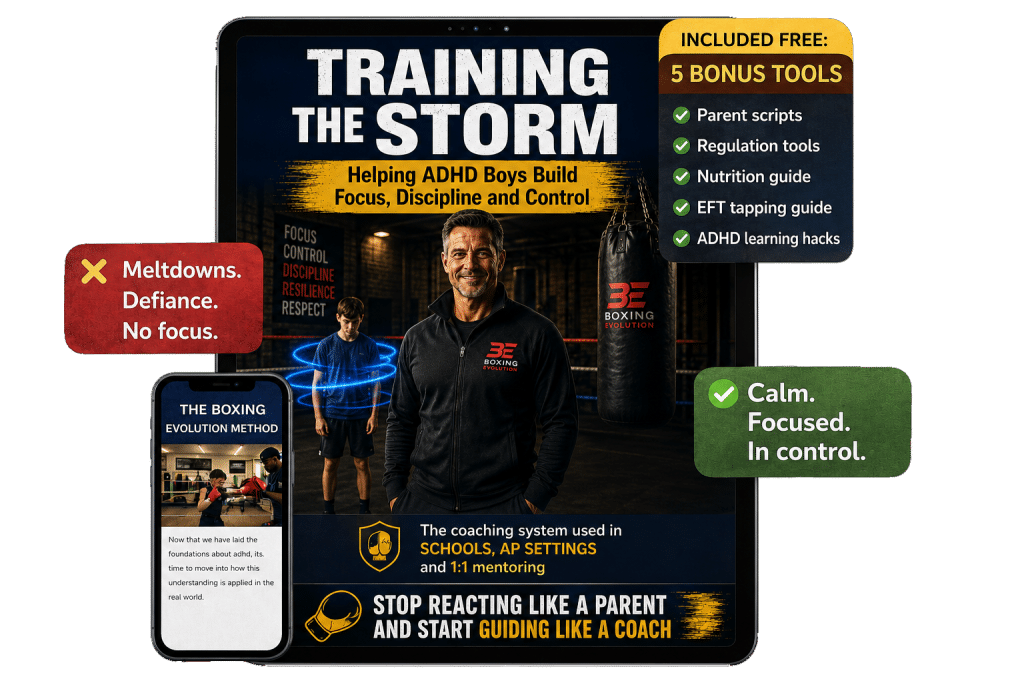
This is one of the many reasons I created ‘Training the Storm’ as parenting ADHD in an effective way that doesn’t destroy confidence and self esteem is so important to a childs development.
The issue is no longer confined to unfinished assignments or poor academic results. It becomes embedded in their identity and can continue shaping their confidence, decisions, relationships and willingness to pursue their potential long after they have left education.
How To Transform Your Challenging ADHD son into a focussed calm kid... without harsh discipline or relying solely on medication

TRAINING THE STORM
A Powerful Boxing-Based ADHD Parenting Guide
Inside the guide you will discover:
- How sports coaching principles transform parenting — Apply leadership, structure and skill development instead of constantly reacting to behaviour..
- The unconscious ways parents surrender leadership authority — Discover the everyday patterns that accidentally put your child in control of the dynamic.
- Why emotional regulation is the real battleground in ADHD — Understand what drives meltdowns, defiance and seemingly irrational behaviour.
- How to train emotional regulation — Practical coaching tools to help your child handle frustration, setbacks and strong emotions.
- How to set boundaries without becoming harsh or controlling — Lead with calm authority while reducing arguments, negotiation and power struggles.
- What to do in the moment when things kick off — Simple strategies and scripts for responding without getting dragged into the chaos.
- Why consequences alone often fail with ADHD — Learn when behaviour needs correcting and when the underlying skill needs developing.
- And much, much more — From school and nutrition strategies to communication, emotional regulation and practical tools for everyday ADHD life.
If you’re tired of “quick fixes”, constant battles and parenting advice that doesn’t seem to work with ADHD, then Training the Storm gives you a different approach.
STOP REACTING LIKE A PARENT AND START GUIDING LIKE A COACH
Think of Training the Storm as your parenting coaching blueprint: helping you understand what drives ADHD behaviour, reclaim your leadership role, and apply proven coaching principles to develop emotional regulation, focus, resilience and self-control.
Why ChatGPT has helped me so much
This is why ChatGPT has been transformative for me.
It does not provide intelligence, experience or ideas that I do not possess. It provides external structure for the part of the process I have always found most difficult.
I can express ideas as they arise without first having to force them into a perfect sequence. ChatGPT can help identify the main argument, group related ideas and arrange them into a logical structure. Once that structure exists, I can evaluate it, challenge what is wrong, add my experience and ensure that the finished writing communicates what I intended.
I remain responsible for the ideas and meaning. What has changed is that I no longer have to complete every stage of organisation internally before I can begin writing.
For me, artificial intelligence is not simply a shortcut. It acts as an accessibility tool—external executive scaffolding between the complex picture in my head and an organised written product.
In the same way that speech-to-text can support someone who struggles with physical writing, AI-assisted structuring can reduce the barrier created by difficulties with initiation, sequencing and written organisation.
What should education be measuring?
There is an understandable argument that completing assignments, meeting deadlines and organising ideas are important real-world skills. They are.
However, if a qualification claims to measure competence in a particular subject, we should be honest about how much of the grade measures subject knowledge and how much measures independent executive self-management.
An examination, practical demonstration, structured discussion, staged project and independently written essay do not measure exactly the same combination of abilities.
A more inclusive education system would maintain meaningful standards while giving students different ways to demonstrate what they understand. It would also actively teach and coach the executive skills with which they struggle instead of simply granting more time and hoping they eventually work out how to use it.
My assessment did not show that I lacked intelligence or the ability to learn. It showed a major difference between my capacity to understand ideas and my ability to organise and consistently produce evidence of that understanding.
The problem was not that I couldn’t understand the work.
The problem was that education expected me to demonstrate my understanding through the very processes my disability made most difficult.
#Key take away: A student’s academic output does not always provide an accurate measure of their intelligence, knowledge or potential. ADHD can impair the executive processes needed to initiate, organise and complete work even when the student understands the subject exceptionally well.
When a capable student repeatedly fails to produce work, the question should not only be, “Why aren’t they trying?”
We should also ask:
“Does this assessment method allow them to show us what they actually understand?”
ADHD Parent Support Library
Explore our articles, insights and practical strategies for supporting children with ADHD. Choose a section below to find the topics most relevant to you and your child.
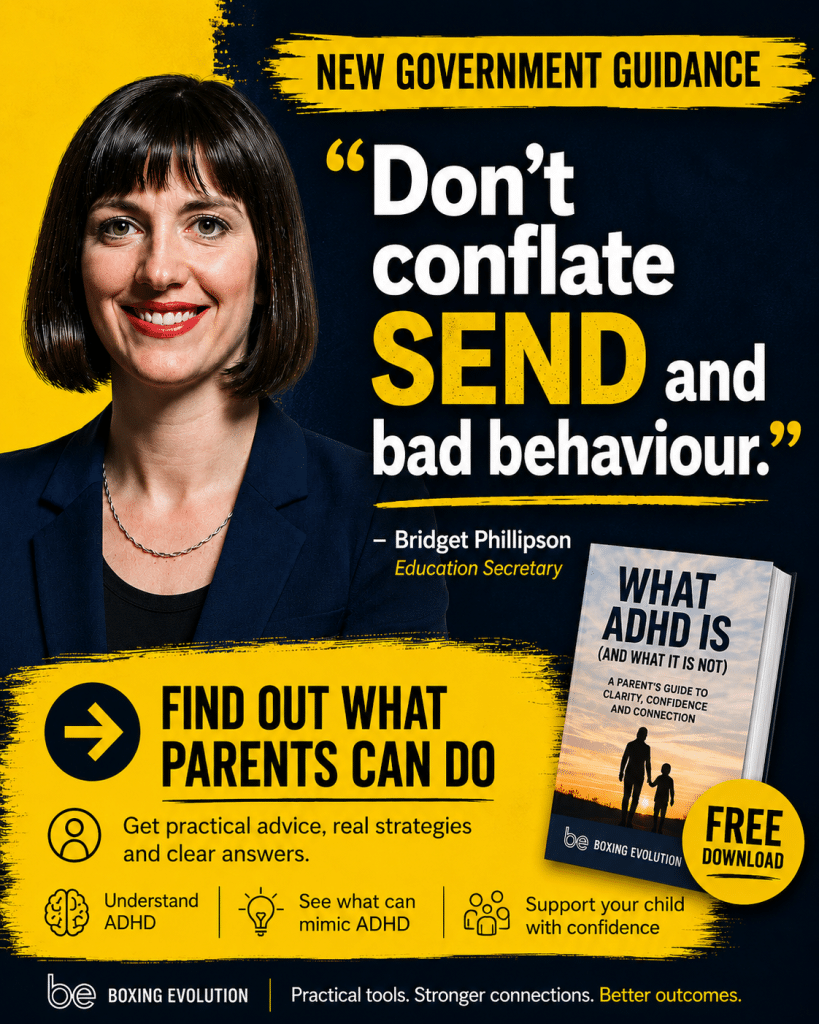
DOWNLOAD THE FREE PDF BY REGISTERING BELOW.